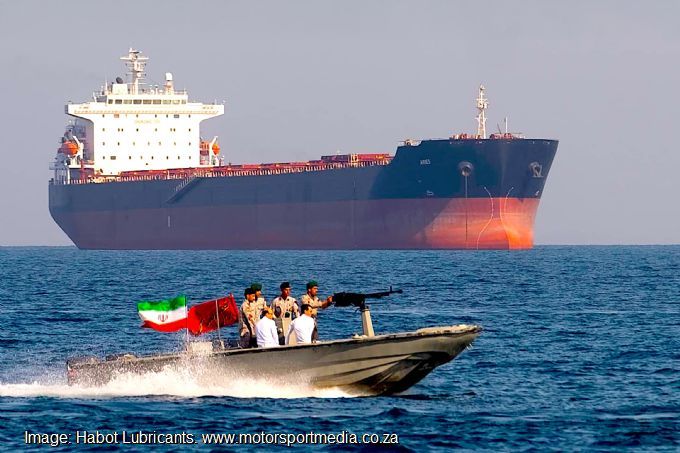
Why the Straits of Hormuz is causing an oil debacle
The world knows exactly how the closure of the Straits of Hormuz is affecting the world as we know it. Simply park at the petrol pump and feel the shock when it comes to paying for a tank of petrol or diesel these days. Of course it will very soon run far deeper, but have you ever considered the challenge the oils and lubrication industry faces in this debacle?
“Let’s just say that this little conflict has thrown our industry into total chaos,” Adam Williamson, marketing manager at Habot Performance Lubricants points out. “According to Rosefield Energy Tech, 20 million barrels of crude oil have been cut from global flows every day since the Straits of Hormuz was blockaded. Which means that base oils and raw additives have been thrown into immediate and cascading shortages.
“On top of that, freight costs have multiplied exponentially, while critical currency depreciation in the likes of the Indian rupee have drastically compounded upon import pressures. The upshot is that the automotive and industrial segments are likely to soften on fuel costs. This is not a temporary blip; it’s a structural disruption and every player in the oil industry is racing to secure supply, raise prices, and hedge risks.”
Looked at in a little more detail, the Hormuz blockade has wiped 20 million barrels of crude out of Middle Eastern outputs a day. Saudi Arabia, the United Arab Emirates, Kuwait, and Iraq are unable to ship crude. Environmental Impact Assessments suggest Brent crude pricing of around $95 a barrel over the next two months. Experts however suggest worst case scenario pricing of $200 per barrel should the closure prolong.
“Refiners are aggressively prioritizing diesel, while shrinking vacuum gas oil yields, directly suffocate base oil production,” Williamson adds. “This is wreaking havoc for any oil supplier, which is in turn making it imperative that we are fast on our feet to stay relevant in an almost impossible marketplace.
“Our best case scenario is ceasefire in the next two months. The market would normalise; base oil deliveries will ease and prices plateau. Most markets are however currently pricing on six to nine months of tension with Hormuz partially blocked, where prices would spike by a third. Even worse is what will happen if this drags on for a year. That would mean prices increasing by another half.”
There are several countermeasures, as Williamson explains: “We need to diversify our oil supply to come from United States, the North Sea, Russia, Korea, and other alternative sources. We must look ahead to multi-origin multi-year contracts and build in four to six weeks of safety stock in spite of inflation. And we must also explore inland or backhaul crude supply routes.
“We furthermore need to consider abandoning fixed pricing for a more dynamic and equitable spot-based pricing formula, lock in critical accounts with premium service and restrict rebates to volume buyers. It is also imperative that we consider shifting blending operations to regional hubs to cut transit times and co-locate additive blending to eliminate secondary freight costs.
“In short, Habot Performance Lubricants and the oil industry on a whole must think broader, act faster and lock in flexibility, not just to do it better, but right now, it’s more to just survive.
“Why is this important, you may ask? Well, every motor vehicle, tractor, compressor, mine, factory must have high quality oils and greases to remain operational,” Adam Williamson concludes. “The blockade of the Straits of Hormuz is testing us harder that we’ve been tested since the fuel crisis of the mid-1970s. Yes, this situation certainly is that serious.”
Issued on behalf of Habot Oils
| What | : | Habot Lubricants Oil Crisis Statement |
| Where | : | Johannesburg |
| When | : | Thursday 16 April 2026 |
| Community | : | South Africa National |
For further information please contact adam@habot.co.za
Click on thumbnails to Download images
 View
View
 View
View
 View
View